














Marketing Case Study: A Complete Framework
Write a defensible marketing case study using SWOT, Porter’s Five Forces and PESTLE, then turn evidence into specific recommendations.
Photo by Campaign Creators on Unsplash
Introduction
If you're studying business, marketing, or management, you've definitely been asked to write a case study on Apple, Nike, Starbucks, or whichever brand your professor is obsessed with this semester. And if you're like most students, you probably described the company for 1,500 words and called it "analysis."
That's the trap. Description isn't analysis. Saying "Nike is a global sportswear company" doesn't tell your marker anything they don't already know.
A good marketing case study reads more like a decision memo. You take messy, incomplete information, figure out what matters, explain why it matters, and make recommendations you can actually back up with evidence. The frameworks in this guide — SWOT, Porter's Five Forces, PESTLE — are just tools to help you do that without drifting into generic filler.
SWOT Analysis: The Foundation of Strategic Thinking
SWOT stands for Strengths, Weaknesses, Opportunities, and Threats. You've probably seen it a dozen times already. It's the most widely used business framework in the world, and there's a reason for that — it forces you to look at a company from both internal and external angles, which is harder than it sounds when you're knee-deep in research.
How to Conduct a SWOT Analysis
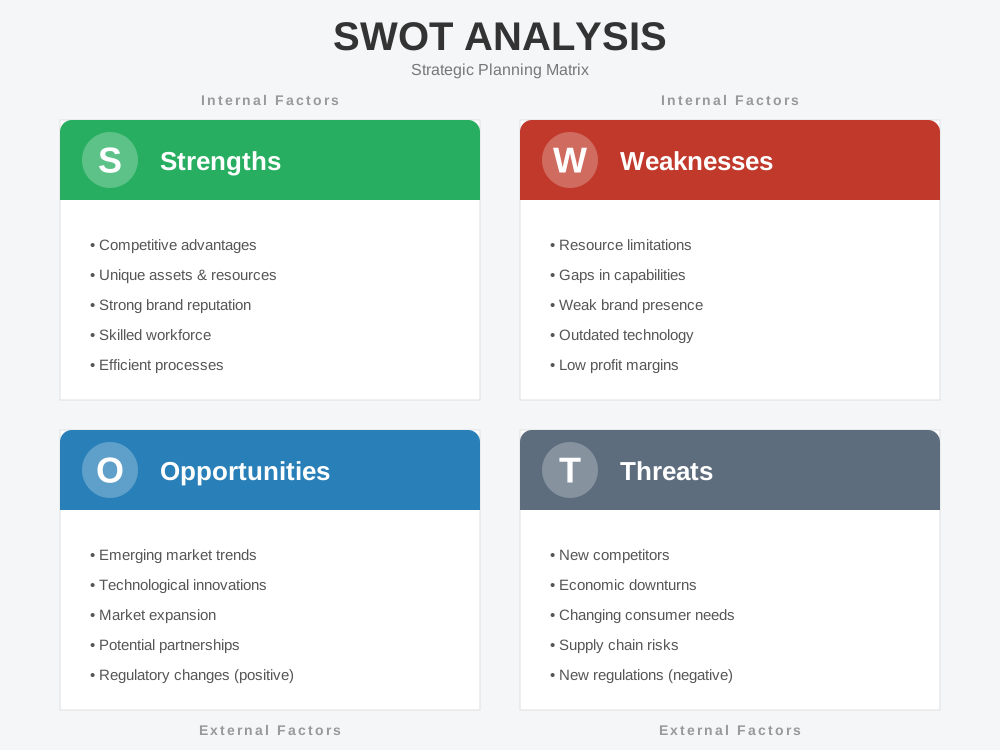
Strengths and Weaknesses are internal — things the company can control. Opportunities and Threats are external — market forces they have to respond to. The framework diagram above lays out the key elements, but the diagram isn't what matters. What matters is what you do with it.
The Thing That Actually Gets You Marks
Don't just list items in each quadrant. Anyone can write "brand loyalty" under Strengths. What your marker wants to see is why that item matters and what evidence you've got for it.
Compare these two approaches:
The lazy version is writing "Brand loyalty" and moving on. That tells your marker nothing.
The better version is something like: "High brand loyalty — evidenced by a strong repeat purchase rate — supports premium pricing, which lifts margins versus competitors." And ideally you'd have a specific number from a recent report to back that up.
That level of specificity is what separates a first from a 2:1. It shows you actually understand the business, not just that you can fill in a template.
Porter's Five Forces: Understanding Competitive Intensity
Porter's Five Forces helps you figure out how competitive and profitable an industry is. It's particularly useful when you're comparing different industries or trying to explain why some companies print money while others barely break even.
The Five Forces Explained
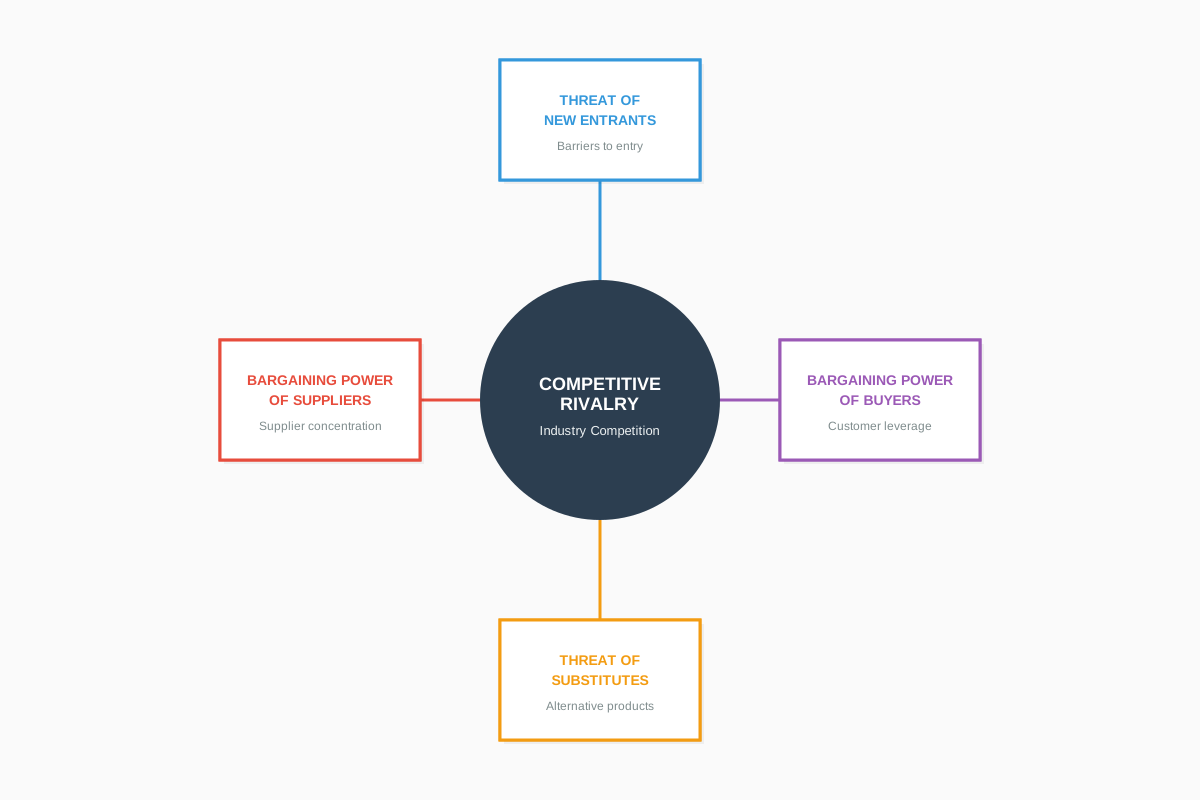
You've got Competitive Rivalry in the centre, surrounded by Threat of New Entrants, Supplier Power, Buyer Power, and Threat of Substitutes.
To make this concrete: fast food has intense rivalry (McDonald's vs Burger King means constant price wars). Airlines have high entry barriers (you need planes, airport slots, and regulatory certification — not exactly a weekend project). Smartphone makers face high supplier power because companies like Qualcomm and TSMC control the chips everyone needs.
Example Application
"Tesla faces moderate competitive rivalry — the EV market is growing, and Ford, GM, and Rivian are all pushing in — but low threat of substitutes, because for eco-conscious buyers there aren't many alternatives to electric vehicles. However, supplier power is high: limited lithium battery producers like Panasonic and CATL have significant control over pricing and capacity."
Notice how that isn't just naming forces — it's explaining why each force matters for this specific company. That's the difference between using a framework and actually analysing with one.
PESTLE Analysis: The Macro-Environmental Context
PESTLE zooms out further than Porter's. It looks at the big-picture external factors that affect all companies in an industry: Political, Economic, Social, Technological, Legal, and Environmental.
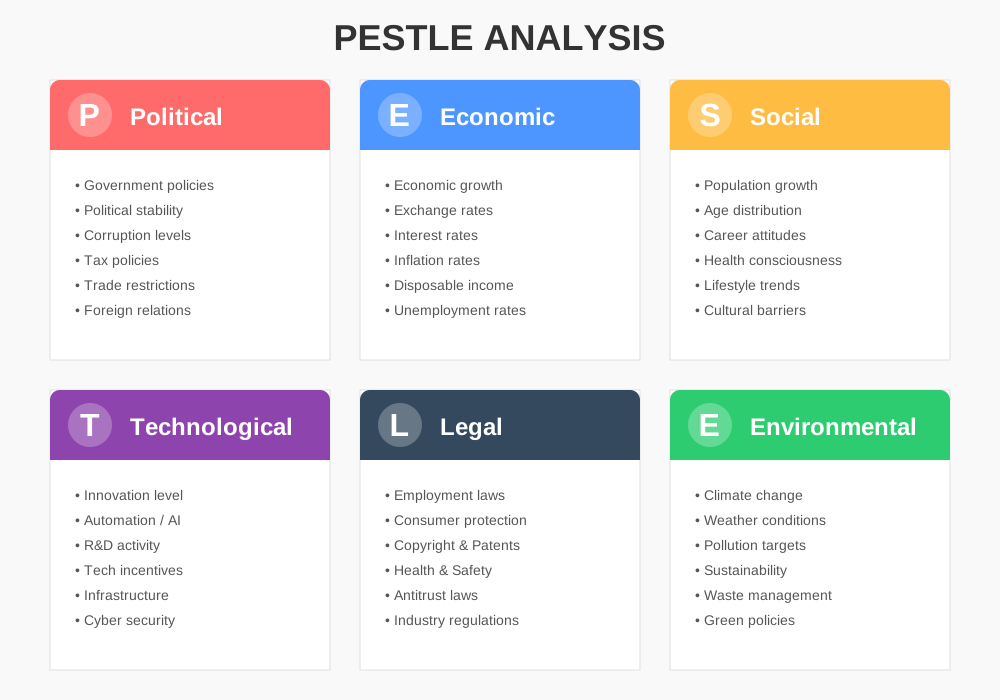
This is especially valuable for global brands. Political covers trade policies and tariffs. Economic looks at GDP and inflation. Social examines demographic trends — Gen Z buying habits, ageing populations. Technological tracks things like AI adoption and digitalization. Legal monitors regulation like GDPR and labour laws. Environmental deals with sustainability, carbon emissions, and ESG trends.
When to Use PESTLE
PESTLE is most useful when you're looking at companies expanding internationally, doing long-term strategic planning, or operating in industries that face heavy regulation (healthcare, finance, energy). If your case study is about a single-market, single-product company, PESTLE might be overkill — but if your assignment specifically asks for it, obviously include it.
How to Structure Your Case Study for Maximum Impact
Recommended Structure
This layout works for most marketing case studies. The percentages are rough guides, not rules carved in stone.
1. Executive Summary (about 10%) — A brief overview of the company, your key findings, and your top 2-3 recommendations. Write this section last even though it appears first. You can't summarise what you haven't written yet.
2. Company Background (about 15%) — Industry context, competitive landscape, company history and current position, key products. Keep this tight. Your marker doesn't need a Wikipedia-level biography.
3. Framework Analysis (about 50%) — This is the core of your case study, and it's where most of the marks live. SWOT, Porter's, PESTLE — whichever frameworks you're using, this is where they go. Use real data for every point. If you make a claim, back it up with a source.
4. Strategic Recommendations (about 20%) — Data-driven, specific suggestions. Not "Nike should do more marketing." More like "Given the Gen Z engagement data from [source], a targeted TikTok influencer campaign could capture the 18-24 segment where competitor X is currently gaining ground." Prioritise by impact, feasibility, and timeframe.
5. Conclusion & References (about 5%) — Summarise, restate your top recommendations, and include proper citations. Harvard Business Review, company investor relations pages, and industry reports are your best friends here.
Common Mistakes That Cost Marks
Describing instead of analysing. "Nike is a successful sportswear company with global presence" is description. "Nike's market position is supported by [specific data point], and its direct-to-consumer strategy gives it pricing power that competitors like Adidas lack in [specific segment]" is analysis. One gets you marks. The other doesn't.
Using outdated data. Markets move fast. A data point from 2019 is ancient history. Stick to sources from the last 2-3 years — recent annual reports, earnings decks, industry publications (HBR, Wall Street Journal, Financial Times). And please, nobody cares that "Nike was founded by Phil Knight and Bill Bowerman in 1964" in a strategic analysis.
Generic recommendations. "Nike should improve its marketing efforts" is so vague it's essentially meaningless. Good recommendations include specific targets, measurable outcomes, and evidence from competitor performance. "What exactly would you do, how much would it cost, and why should anyone believe it would work?" — if your recommendation can't answer those questions, it needs more work.
Habits That Quietly Lift Your Grade
Use the "So What?" test. After every point you make, ask yourself: "So what? Why does this matter for the business?" If you can't explain the impact, it probably doesn't belong in your case study.
Compare to competitors. Don't analyse in a vacuum. A company's market share only means something relative to its competitors. "Nike's position vs Adidas vs Puma" — with actual numbers — shows you understand the competitive context.
Reference recent events. Product launches, acquisitions, quarterly earnings, market disruptions — these show your marker you're engaged with the real business world, not just parroting a textbook.
Use visual data. Charts, tables, and matrices aren't decoration — they show you can present information clearly. A SWOT matrix, a market share comparison chart, a financial trend analysis — these make your case study look professional.
Ready to Write a Stronger Case Study?
Understanding frameworks is the starting point. Applying them with genuine strategic insight — specific data, original analysis, recommendations that would actually make sense in a boardroom — is what gets you the grade.
The gap between a B and an A isn't knowing what SWOT stands for. It's demonstrating that you can think through a business problem methodically and come out the other side with something useful to say.
FAQ
What's the best structure for a marketing case study?
Executive summary → company background → framework analysis → recommendations → conclusion and references. The most important thing is that your analysis section takes up the most space — not company history.
Should I use SWOT, Porter's Five Forces, and PESTLE all together?
Only if each one is genuinely adding something to your argument. Two well-argued frameworks beat three shallow ones every time. Pick the tools that best explain the situation and answer the question you've been asked.
Where can I find good data sources for a case study?
Company annual reports and earnings decks are your foundation. Add in industry reports from firms like Gartner or McKinsey, and supplement with business publications like HBR, FT, and the WSJ. Your university library probably has access to databases like Statista and IBISWorld too — check before you pay for anything.
How do I write recommendations that aren't generic?
Tie each recommendation to a specific finding from your analysis. Define who it targets, explain the likely cost and trade-offs, and set a measurable outcome. If you remove the company name and your recommendation could apply to literally any business, it's too vague.
Ready to Write a Professional Marketing Case Study?
Frameworks are tools—the grade comes from how you use them. If you want help turning messy info into a clear analysis and recommendations you can defend with sources, we can help.
If you're struggling with:
- Unsure how to apply SWOT, Porter's Five Forces, or PESTLE effectively
- Struggling to find relevant data and recent sources
- Need help structuring analysis with strategic depth
- Want recommendations that are specific, not generic
Here's how we'd coach you through it:
Send us your draft or your question. We'll walk you through:
- Framework application guidance (SWOT, Porter's, PESTLE)
- Strategic analysis and business case development
- Data-driven recommendation formulation
- Professional case study structuring